Bachtrack reviews Written on Skin
Read the great review from Bachtrack, one of Europe's leading classical music magazines
New Meets the Time-Honored: *Written on Skin* at the Bergen National Opera
By Alexandra Richter, November 9, 2026
Read the original review in German here
*Written on Skin*, by George Benjamin and Martin Crimp, stands—perhaps more than any other work—as a testament to the triumph of contemporary opera and the enduring vitality of a genre that is over 400 years old. Since its premiere at the Aix-en-Provence Festival in 2012, the opera has been staged in numerous venues, both large and small, across the globe, firmly establishing itself within the canon of contemporary operatic literature. Katie Mitchell’s production—the same one used for the world premiere—has also traveled to many opera houses; it is now being presented at the Grieghallen in Bergen, Norway.
Although Norway has produced some world-class singers (such as Kirsten Flagstad and Lise Davidsen), the operatic tradition in the country—even in the capital, Oslo—is quite young. While the Bergen Philharmonic Orchestra ranks among the oldest orchestras in the world (founded in 1765 and led for several years by Bergen’s own Edvard Grieg), the Bergen National Opera was not established until 20 years ago. The company performs at the Grieghallen, which opened in 1978. Thus, this evening brings together the old and the new—a long-standing tradition meeting fresh, contemporary ideas.
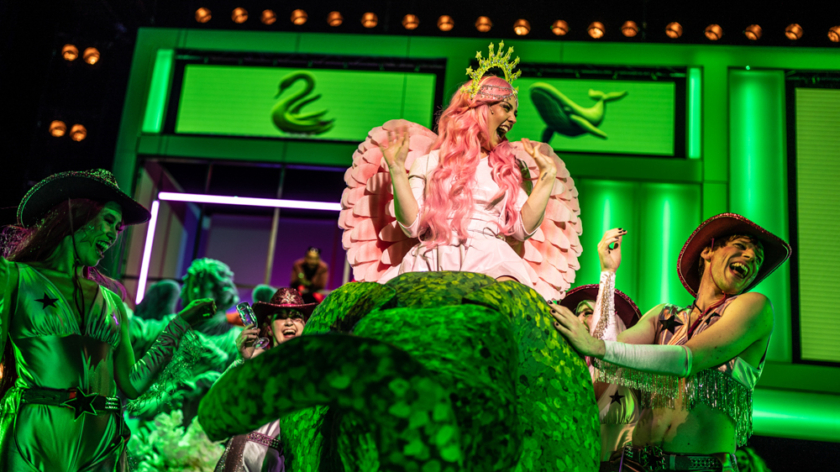
It is perhaps not surprising that such a young institution—one that has never shied away from contemporary music—would choose a 21st-century work for its anniversary gala. Yet, the choice also underscores the significance of contemporary repertoire to the company, reflecting an ongoing commitment to innovation and a desire to introduce audiences to the widest possible spectrum of operatic literature. The festive evening was divided into two parts, beginning in a lighthearted and accessible vein: an opera gala featuring well-known arias and scenes that offered a brief retrospective of the last 20 years—ranging from *Carmen* and *Eugene Onegin* to *Die Fledermaus*. This was followed by a much heavier, decidedly macabre offering: the opera *Written on Skin*, which centers on a woman who is served the heart of her lover by her vengeful husband.
The story—rooted in Boccaccio’s *Decameron* and the legend of the troubadour Guillem de Cabestanh, known as *Le Cœur mangé* ("The Eaten Heart")—proves to be ideal operatic material in many respects. The wife’s naivety and simplicity—compounded by the fact that she is illiterate and trapped within her marriage—render her a deeply pitiable figure. At the same time, the shocking, cold-blooded cruelty of her husband and the repercussions of his actions elevate the opera’s tragedy to the level of the great classics of the genre.
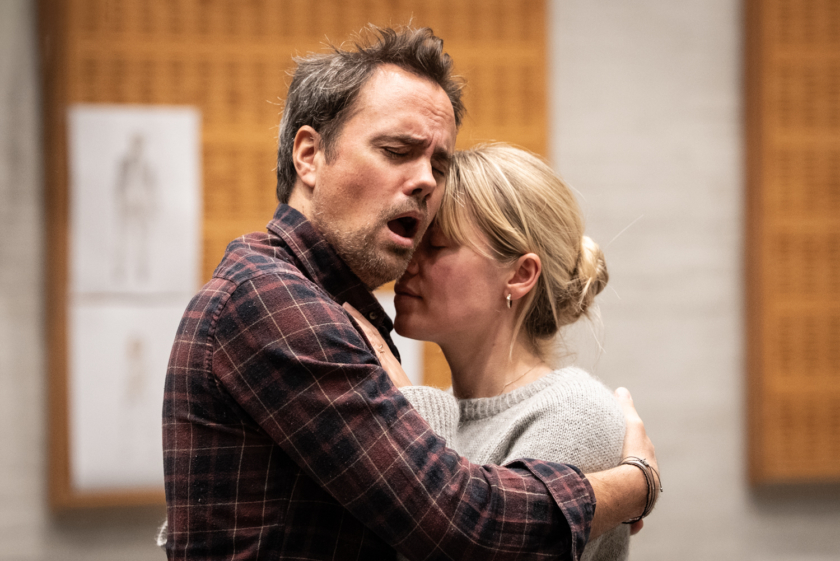
In her signature style, director Katie Mitchell divides the stage into several distinct spaces. While the narrative unfolds within a setting evocative of the story’s original era—we see the "Protector’s" house, rendered in a Provençal style—the adjacent, modern-day rooms establish a meta-level. This space functions as a kind of clinically sterile archive, where staff members orchestrate the events, ensuring that the story plays out exactly as it has before. Characters are dressed and undressed, positioned with care, and the props they use are subsequently processed and stowed away with professional precision. One cannot help but wonder: how many times has this drama played out? This approach creates a sense of repetitive timelessness, while simultaneously establishing a distance from the harrowing events of the story. Mitchell’s production elegantly strikes a balance between a clinical austerity—which is at times reflected in the libretto and language—and the mysticism and poetry that are equally inherent to that same language. This duality creates both intimacy and distance, demonstrating that stories from the 13th century can indeed remain relevant in the here and now.
While many of the singers are making their role debuts, Mark Stone—cast as the Protector—is already familiar with his part. With his rich, virile voice, he portrays a domineering patriarch who is nonetheless susceptible to the charms of the Boy. He is cruel, yet, much like his wife, he yearns for affection and a desire to be truly seen.
Mari Eriksmoen embodies Agnès, initially as a naive, innocent wife, trapped within her home and the limited possibilities of her life. Over the course of the opera, she undergoes a process of emancipation that ultimately leads to her self-destruction. Vocally, she conveys this fragility through a delicate soprano. Countertenor Alexander Chase possesses a weightless, ethereally fluid voice, imbued with a sense of allure and youthful naivety. Christina Jønsi as Marie and Magnus Staveland as John complete an outstanding ensemble performance.
The Bergen Philharmonic Orchestra, conducted by Lawrence Renes, illuminated the score in a tangible and stirring way. Rene's conducting was extremely lively, with a sense of drama and exaggeration. Between tutti bordering on cacophony that erupt dramatically, he repeatedly explored the fragile passages that underline the humanity of the story. He and his orchestra were able to exploit the interesting instrumentation - with rich percussion, but also glass harmonica and viola da gamba - transparently and virtuosically.
It was an evening of contrasts and dualities. Old and young. Known and new. The Bergen National Opera has shown that the opera genre in Scandinavia is more diverse and diverse than almost any other. You don't have to make a decision, but you can combine apparent opposites and create completely new traditions.
Read the article on Bachtrack (in German)
Translated to English from the original language German